Phase Separation: When Stuff Splits Into Teams
A quick picture in your head
Shake a bottle of salad dressing. It looks mixed for a moment. Then it splits into two layers again. That split is phase separation. It happens when one mix turns into two parts that stay apart.
A “phase” is a region with its own look and feel. One phase can be watery. One phase can be oily. One phase can be thick like gel. Phase separation can happen in foods, in plastics, in batteries, in living cells.
Everyday phase separation you already know
Oil and water
Oil molecules like to stay with oil. Water molecules like to stay with water. Oil does not mix well with water, so they separate into layers. Shaking breaks oil into tiny drops. The drops bump into each other. The drops join again. The layers come back.
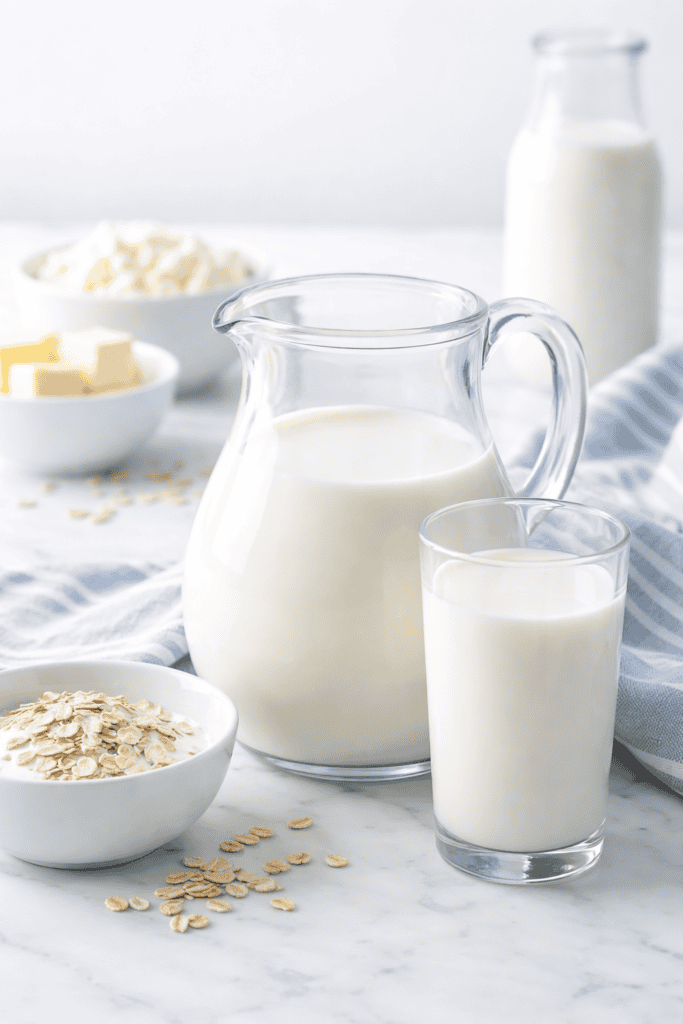
Milk and cream
Milk is a mix of water, fat, and proteins. Fat can gather into tiny droplets. Those droplets can move and join. You can see cream rise in some milk. That is phase separation in a food system.
Chocolate that turns white
Old chocolate can get a white coating. Fat can move and gather at the surface. Sugar can gather too. This is a kind of separation inside the chocolate.
What makes phase separation happen
Molecules choose neighbors
Many molecules have “preferences.” Some like water. Some hate water. Some carry electric charge. Some have no charge. When a mix has many molecules with different preferences, the mix can split.
Energy and order
Mixing can cost energy. Separating can save energy. Nature tends to pick the lower energy choice. That choice can be two phases instead of one.
Temperature, salt, and pH can flip the result
A mix can be one phase at one temperature. The same mix can split at another temperature. Salt can weaken electric attraction. Acids and bases can change charge. These changes can push a mix toward separation.
Phase separation inside living cells
Cells have many parts with membranes, like the nucleus. Cells have parts with no membrane too. These are often called biomolecular condensates. They form when proteins and RNA gather into droplet-like groups by liquid–liquid phase separation. These droplets can grow, shrink, fuse, and split.
A simple idea helps. A cell is crowded. Some molecules need to meet fast. A droplet can concentrate them in one spot. The droplet can form when the cell needs it. The droplet can dissolve when the cell is done.
Scientists study this because it links to health and disease. Scientists study it because it looks like a new way to build tools inside cells.
New technologies using phase separation
1) Tiny droplets that deliver medicine
Some new drug carriers are made from coacervates. A coacervate is a droplet formed by phase separation, often driven by electric attraction between charged molecules. These droplets can load helpful cargo like proteins or RNA. The droplet can protect the cargo. The droplet can release the cargo when conditions change.
Researchers are building peptide-based droplets that can enter cells. The design can control when the droplet stays together and when it lets go of the cargo. This is useful for drug delivery ideas.
How it works in simple steps
- Pick two molecules that attract each other in water.
- Mix them at the right amounts.
- Droplets appear like tiny beads.
- Put a drug inside during mixing.
- Use a trigger like pH or enzymes so release can happen in the target place.
2) Light switches for cell droplets
Scientists can control some condensates with light. Light can make proteins stick together more. Light can make them separate. This gives control over where droplets form inside a cell and when they dissolve.
This matters because normal cell droplets are hard to study. They form fast. They move fast. Light control lets researchers test cause and effect. It helps them learn what droplets do in real time. Reviews describe “optogenetic” tools that turn condensation on and off with precision.
A kid-level analogy
Think of glow-in-the-dark magnets. Shine a light. The magnets “wake up” and clump. Turn off the light. The clump fades.
3) 3D printing in water using two watery phases
Most 3D printing happens in air. Some new work prints inside water. It uses an aqueous two-phase system. That means two liquids that are both mostly water, yet they still separate like oil and water. One phase can hold a “ink” material. The other phase can act like a “bath” that supports the printed shape.
This can help when you want soft, wet materials like gels. It can help for tissue-like materials. It can help for making multi-part structures in one step. Scientists have shown methods that use phase separation to form gels with different regions and strong interfaces.
Why this is cool
- Everything stays wet.
- Soft parts do not collapse as easily.
- Different zones can be printed in one object.
4) Microfluidic “droplet factories”
Microfluidics uses tiny channels to move liquids like a mini plumbing system. When two phases meet in a tiny channel, the flow can pinch off droplets in a very controlled way. This can make thousands of same-size droplets per second.
Some groups use phase separation in microfluidic setups to build 3D objects inside channels. This can turn phase separation into a manufacturing trick.
5) Biosensors that “light up” when molecules gather
A biosensor is a tool that detects something. Some new biosensors use phase separation as the signal. A target molecule can cause droplets to form. The droplets can concentrate a dye. The dye can get brighter. The change can be easy to see.
Researchers describe LLPS-based biosensing methods that help track protein interactions and enzyme activity.
6) Better battery parts made by phase separation
Batteries need electrolytes that move ions fast. They need materials that stay tough. Some researchers use in situ phase separation to form ionogel or polymer structures that hold lots of liquid electrolyte while staying solid enough to handle bending. Some work describes phase-separated electrolytes aimed at better ion transport and stronger materials.
A simple picture
- Start with a liquid mix.
- Let a polymer form inside it.
- The mix splits into two regions.
- One region carries ions well.
- One region gives strength.
References
- Review on optogenetic control of biomolecular condensates (2024). (ScienceDirect)
- Review on optical control over liquid–liquid phase separation (2024). (PubMed)
- Phase-separating peptide coacervates for intracellular delivery (Nature Communications, 2024). (Nature)
- Review on smart coacervate microdroplets for drug delivery (2025). (ScienceDirect)
- Aqueous two-phase systems for delivery and materials (2024). (ScienceDirect)
- One-step gel fabrication using aqueous phase separation (Nature Communications, 2023). (Nature)
- 3D printing of aqueous two-phase systems with polyelectrolytes (Angewandte Chemie, 2024). (Wiley Online Library)
- In situ 3D polymerization using an aqueous two-phase system in microfluidics (Biomicrofluidics, 2024). (AIP Publishing)
- LLPS-based biosensing overview (2025). (Chemistry Europe)
- Phase-separated battery electrolyte examples (2024–2025). (ScienceDirect)